














Jason Seidel, Psy.D.
Licensed Psychologist
303-377-0999



search our site:
Please Note: The Colorado Center is in a multiyear study of psychotherapy outcomes methods. Our newer data are presented above older data. As sample sizes increase with the new methods, we will 'retire' older data that appear lower on this page.

75% of clients had more than 4 sessions
50% of clients had more than 9 sessions
25% of clients had more than 21 sessions
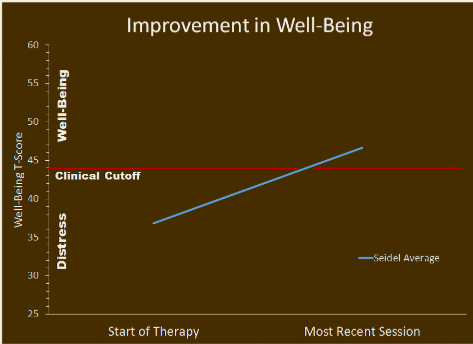
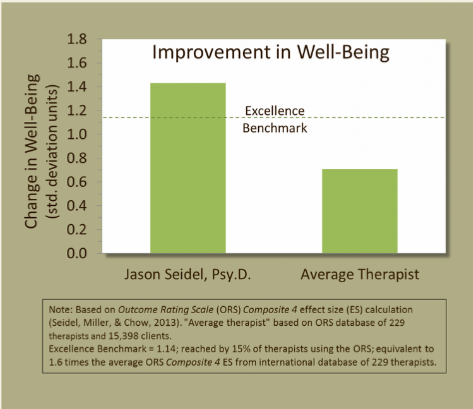
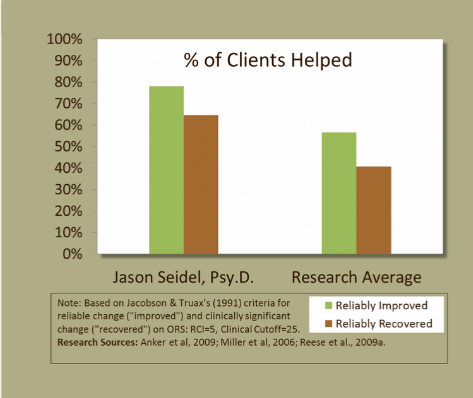
78% of clients ended therapy with greater well-being (40-60% is typical)
4% of clients ended therapy with worse well-being (10% is typical)
95% of the intended sample was analyzed
What is the "intended sample"? Adults coming for their first treatment episode who had at least 2 sessions. So 5% of these clients had data missing, whether from a botched administration or refusal to participate in some way. "Treatment episode" means a single course of therapy where a client comes in, has sessions, stops therapy, and does not return for over 8 weeks. Below, we account for all data left out of the analyses.
32% of episodes were returning clients
10% of episodes were a single session
1% of episodes were clients younger than 15
Why not include returning clients (meaning those that came back after being gone for at least 8 weeks)? Returning clients typically have greater well-being than "first-episode" clients. We consider returning clients to be a measure of "client satisfaction" and we want our analysis to be strictly about change in well-being, comparable to research with new clients only.
Why not include single-session clients? Single sessions may be intentional (e.g., a brief consultation), or the result of shopping around, or dissatisfaction with the therapist. Change can't be measured if there are not at least two measurements of well-being.
Why not include clients younger than 15? Younger clients score their well-being differently than adults do, so different norms are needed. In general, younger clients tend to rate their own well-being higher than adults do (and higher than parents rate their children).
Barkham et al, 2001; Brown 2005, 2006; Hansen et al, 2002; Harmon et al 2007;
Hawkins et al, 2004; Seidel et al, 2013.


